
The Bharatiya Janata Party on Tuesday said it held a formal meeting with a Chinese delegation openly, given the "improved" relations between New Delhi and Beijing, unlike the Congress which, it alleged, "secretly" signed a memorandum of understanding with the neighbouring country's ruling party.

The agreement was to disengage from remaining standoff sites along the Line of Actual Control (LAC), two days before a meeting between Chinese President Xi Jinping and Prime Minister Narendra Modi on the sidelines of the BRICS Summit.

'What needs to be watched is that the border incidents at Dokalam in 2017 and Galwan in 2020 are triggering nascent Chinese nationalism against India,' asserts Srikanth Kondapalli, the leading China expert.

With his eye on next year's Party Congress, Xi Jinping is using the CCP's centenary celebrations to publicise the benefits for China from its leadership, and boost his image and contribution to China's rise, observes Jayadeva Ranade, the distinguished China expert and retired RA&W officer.

The Trump administration has revoked Harvard University's eligibility to enrol foreign students, raising concerns over the legal status of thousands of students, including nearly 800 from India, currently enrolled at the varsity.

Passed by the House by 352 to 65 votes, the bill now heads to the US Senate for it to be sent to the White House for the President to sign it into law.

In its set of recommendations, the China Committee said that economic sanctions against China in case of an attack on Taiwan will be most effective if key allies such as G7, NATO, NATO+5, and Quad members join, and negotiating a joint response and broadcasting this message publicly have the added benefit of enhancing deterrence.

'Even though as Xi will seemingly continue to stay in power beyond his third term, competitions for the post-Xi leadership would be inevitably unfolded beneath the surface of water, and that will be a big headache for Xi the dictator.'

A visit to Tibet appears to have become the new touchstone for expressing fealty to Xi Jinping, observes Jayadeva Ranade, the retired senior RA&W officer and distinguished China expert.

A legislation has been introduced in the United States Congress for countering the Chinese propaganda by creating a new sanctions authority against state-backed disinformation networks.
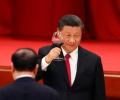
President Xi Jinping, who has been occupying the top post since 2012, was unanimously chosen as a delegate to the ruling party's 20th national congress at the CPC Guangxi regional meeting on April 22.

In Tokyo, hundreds of Japanese citizens came out on the streets to express solidarity with the oppressed people of Tibet, Xinjiang, Mongolia, Hong Kong and Taiwan.

The Chinese Communist party's central committee on Thursday, November 11, adopted a landmark resolution on the party's 'major achievements and historic experiences', effectively consolidating CCP General Secretary Xi Jinping's lifelong hold on power.

One Chinese source informed ANI that 10 million new infections are probably occurring daily in China.
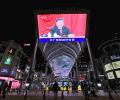
Support from the committee gives Xi an indefinite extension on the reins of power, which will surely result in hawkish and insular policies. It does not bode well for relations with the USA, or with anyone else who does not bow the knee to Beijing, for that matter.

'The Modi government is trying to suppress the matter only to save its political image'
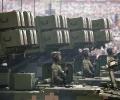
There is growing alarm at the inexorable rise of China, both of its military prowess and its aggressive bullying of other countries plus its subjugation of whole portions of its own population.
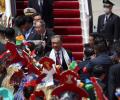
Wang Yang and Xi Jinping's visits signal the beginning of a major Chinese push to bring about a transformation of Tibet, observes Jayadeva Ranade, the distinguished China expert and retired RA&W officer.
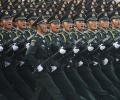
Protests at this time when efforts are underway to strengthen the PLA and keep morale high would be worrying for the military leadership, observes Jayadeva Ranade, the retired senior RA&W officer and distinguished China expert.

Why is China's supreme leader promoting Han Chauvinism so aggressively, asks Claude Arpi.

Two elderly Chinese aerospace experts are hospitalised after a violent attack by a 'Princeling', states Jayadeva Ranade, the distinguished China expert and retired RA&W officer, highlighting the power the 'Princelings' ironically hold in the Communist People's Republic.

The government is looking at a new timeline for Air India disinvestment and financial bids will be invited in the coming days, Union minister Hardeep Singh Puri said on Friday. Noting that there is no choice but to either "privatise or close" Air India, he said the government will have to keep the airline running till it gets divested. "We are looking at another timeline now, what is called data room for prospective bidders to look at... that is opened up, 64 days for the financial bids to come in. "After that it is the question of taking a decision and handing over the airline," the Minister of State for Civil Aviation said.

The future challenger to Narendra Modi would be somebody who can bring the Hindus and Muslims together again. The Hindus as Hindus, not broken caste groups, asserts Shekhar Gupta.

Xi, 68, holds China's all three power centres -- General-Secretary of the CPC, Chairman of the powerful Central Military Commission which is the overall high command of the military, and the Presidency is set to complete his second five-year tenure next year.

All that India must aim for is to match China's military prowess adjusted to equal Beijing's India-specific military capability, argues Vivek Gumaste.
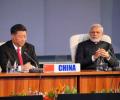
'Under General Secretary of the Chinese Communist Party (CCP) Xi Jinping, Beijing has stepped up its aggressive foreign policy toward New Delhi. Since 2013, China has engaged in five major altercations with India along the Line of Actual Control (LAC),' said a brief issued by US-China Economic and Security Review Commission.
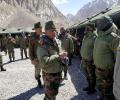
The military preparations underway show that the PLA may undertake operations this summer to achieve whatever objectives they could not achieve last May, asserts Jayadeva Ranade, the distinguished China expert and retired RA&W officer.

It will be interesting to see whether India-China border tensions figure during the deliberations of PLA deputies to the NPC and CPPCC, notes Jayadeva Ranade, the distinguished China expert and retired RA&W officer.
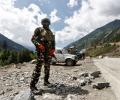
'How Xi Jinping will withdraw the aggression and justify it to his Communist party in case of a negotiated settlement might be his biggest headache.' 'Unless he is ready to gamble on an armed conflict, whose outcome given India's battle-readiness and determination is always uncertain,' observes Virendra Kapoor.
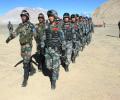
Esper also highlighted the 'increased' military cooperation with India and called it as 'one of the most important defence relationships of the 21th century'.

There are signs of China's external behaviour becoming more aggressive in the coming years. If that happens, strategic implications for neighbours having territorial disputes with China can become deeper and imperatives can rise for the former to counteract, says D S Rajan

'China's latest defence White Paper has been issued against the backdrop of the upgraded Sino-Pakistan strategic relationship which has impinged on India's sovereignty and territorial integrity, and Beijing's continuing intransigence on tackling the issue of the disputed border or intrusion by PLA troops,' says Jayadeva Ranade.
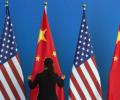
Chinese observers believe the Sino-US relationship will be impacted by issues in North Korea, Japan, India, Ukraine and Iran and that conflicts with these 'third parties' will without exception ultimately become conflicts between China and the US, points out former RA&W officer Jayadeva Ranade.

'Is Xi's China stable?'
'No one can say whether the regime will fall all at once or if its leaders are devising a new solid and competitive -- anything but democratic -- model.' A fascinating excerpt from Francois Bougon's Inside The Mind of Xi Jinping.

'After a strategic pause though, Beijing will revive its policy of slowly creeping towards acquiring sovereignty over the South China Sea.'
 © 2026 Rediff.com - Advertise with us - Disclaimer - Privacy Policy - Sitemap - Feedback - About us - Terms of use - Grievances